How Your Notes App Turned Into a Second Inbox (And Started Eating Your Brain)
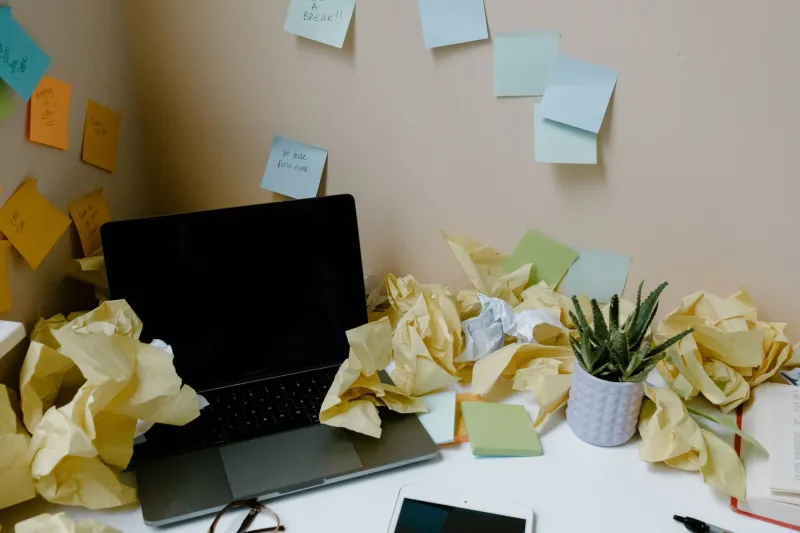
There's a moment most knowledge workers can relate to, even if they've never put words to it. You open your notes app with a half-formed idea you want to develop. You're maybe thirty seconds in when you spot an unread comment from a teammate, a flagged item from last week's meeting, a pinned message that technically needs a response. The idea you came to work on? Gone. Evaporated. You've just checked your second inbox.
This isn't a bug. It's kind of by design — and that's the problem.
The Slow Collapse of a Thinking Space
Notebooks used to be boring in the best possible way. A legal pad, a spiral-bound Mead, even a plain text file — these were dead ends in the most productive sense. Nothing came in. You went there to make something. The absence of inbound noise was the whole point.
Modern note-taking tools changed that contract quietly. Shared workspaces, comment threads, @mentions, real-time collaboration cursors — these are genuinely useful features for teams. But they arrived in the same interface where you're supposed to be doing your deepest solo thinking. The result is a cognitive blender. Your tool for building ideas now behaves like the tool you use to manage other people's requests.
Psychologists who study attention would call this an "affordance mismatch" — when the design signals of a tool suggest behaviors that conflict with your actual goals. Every notification badge on a notes app is a tiny signal that says this is a reactive space. And once your brain learns that, it becomes nearly impossible to use the same space for proactive, generative work.
Why "Just Ignore It" Doesn't Work
The obvious answer sounds simple: just don't look at the notifications. Turn them off. Close the sidebar.
Except that's not really how attention works. The awareness that notifications could be there is often enough to degrade the quality of your thinking. Researchers at UC Irvine found that it takes an average of over 23 minutes to fully return to a task after an interruption — but less-discussed is the finding that anticipated interruptions can fragment attention even when no interruption actually occurs. You're pre-loading the context switch before it happens.
This is why inbox-style anxiety has colonized our notebooks. You don't need to see a new comment to feel the pull of it. The knowledge that your notes app is also a communication layer changes how you inhabit it, even in silence.
The Capture Trap
There's a second layer to this problem that has less to do with collaboration features and more to do with how we've internalized productivity culture's obsession with capture.
For the last decade, the dominant advice in knowledge-worker circles has been some version of: get it out of your head and into your system. That's not bad advice on its own. But it metastasized. Somewhere between GTD and the Zettelkasten renaissance, "capture everything" became a reflex rather than a strategy. The inbox — once a temporary holding zone — became a permanent residence.
Open almost any heavy note-taker's app today and you'll find a sprawling, undifferentiated mass of half-thoughts, clipped articles, voice memos, screenshots, and abandoned outlines. It's not a thinking environment. It's a digital attic. And just like a cluttered physical space, a cluttered notes environment doesn't just fail to help you think — it actively makes thinking harder.
The psychological term here is "cognitive load." Every unprocessed item in your capture inbox is a small, persistent tax on your working memory. You're not just storing information; you're storing unresolved decisions about what that information means and what you're supposed to do with it.
Reclaiming the Contemplative Layer
So what's the fix? Not abandoning collaborative tools — those serve real needs. The move is architectural: deliberately separating your reactive layer from your generative layer.
Think of it as zoning your digital workspace the way a well-designed office zones physical space. You wouldn't put your focused reading chair next to the printer where people congregate. The same logic applies to your notes.
Create a hard boundary between capture and development. Your quick-capture inbox — the place where raw thoughts, meeting notes, and clipped links land — should be functionally separate from the space where you actually develop ideas. Some people use different apps entirely. Others use strict folder or tagging conventions. What matters is that when you enter your development space, your brain knows it's a one-way door. Nothing comes in here. You only build.
Set a processing cadence, not a processing reflex. Instead of triaging your capture inbox whenever you happen to open your notes app, schedule it. Twice a day, once a day, whatever fits your rhythm. The goal is to stop treating your inbox like a live feed and start treating it like mail. You process it on your schedule, not its schedule.
Audit your collaboration surface. If your team genuinely needs a shared notes environment, consider whether that environment needs to be the same one where you do your private thinking. Tools like Notion, Confluence, and Coda are excellent for shared knowledge bases. They're often lousy thinking environments precisely because they're so good at the social layer. It's okay to use one tool for team coordination and a different, quieter tool for your own cognitive work.
Protect at least one notebook that no one else can see. This sounds almost embarrassingly simple, but it matters. The psychological experience of a private, unshared space is different from a shared one — even if you're the only one who ever looks at either. Privacy isn't just a security feature. It's a cognitive permission slip to think badly, think partially, think out loud without performing competence.
The Notebook as a Lab, Not a Lobby
Here at NotebookLabs, we think a lot about what it means for a notebook to actually function as a lab — a place where raw material gets transformed into something useful. Labs have lobbies, sure. People come in, drop things off, ask questions. But the lab itself is protected. You don't do experiments in the lobby.
The best thinkers we know — writers, engineers, designers, strategists — treat their notes the same way. The inbox is the lobby. The notebook is the lab. And the work of protecting that distinction is ongoing, because the tools will always try to collapse it.
Your best thinking doesn't happen in a reactive state. It happens in the deliberate, slightly boring, notification-free space you have to actively defend. That space is worth defending.
Because the ideas that come out of it? Those are worth something. The inbox can wait.